Private Label Intimate Products: Types, Formats & OEM Guide
Private label intimate products are not one product but a category — washes, foams, sprays, creams, serums and capsules, each with its own filling line and regulatory track. Here is the format map, and the five documents that separate a real manufacturer from a trading company.
For B2B buyers sourcing private label intimate products: the phrase covers a wide and uneven category. A feminine wash, a pre-filled foam applicator and a softgel capsule may sit under the same supplier's quotation, but they are made on different filling lines, tested to different standards, and in some markets sold under different regulatory identities.
Buyers who treat the category as a single SKU usually find this out after sampling — when tooling, packaging and timelines are already committed. This guide maps the formats first, then sets out how to confirm that a manufacturer is genuine before you commit.
Who this guide is for: Brand owners, procurement managers and product developers building a private label intimate care or feminine wellness line for pharmacy, clinic, e-commerce or DTC channels.
What Counts as "Private Label Intimate Products"?
Private label means the product is manufactured on a proven base formula and sold under your own brand — as opposed to a fully custom formulation developed from your brief. The category it covers, however, is broader than most first-time buyers expect.
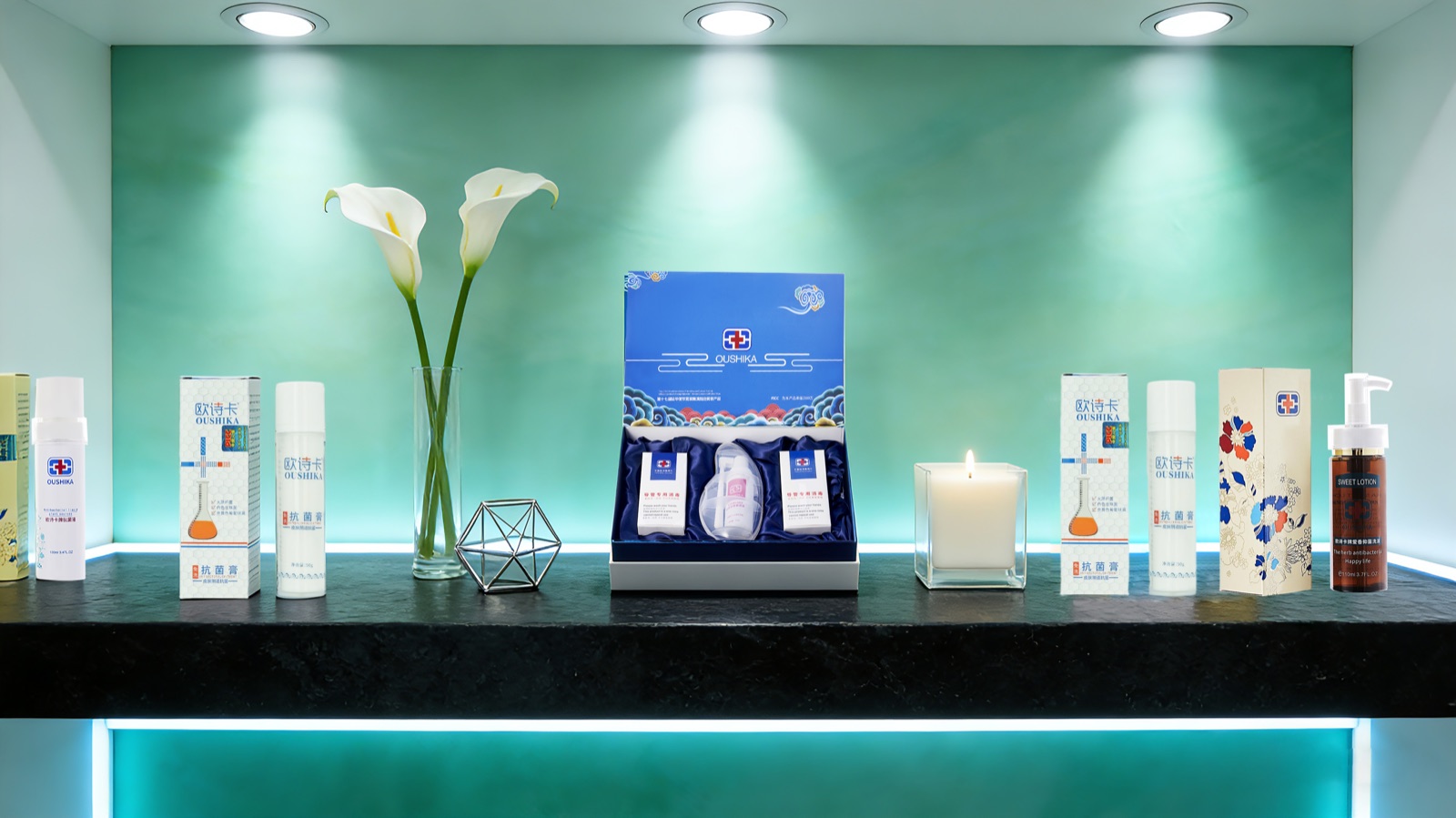
The format is the first decision, because it determines the filling line, the packaging engineering, the stability testing and, in many markets, the regulatory identity of the finished product. The table below maps the formats most commonly requested by brand owners, and what each one changes downstream.
| Format | Typical Pack | What It Changes for Your Brand |
|---|---|---|
| Feminine wash / cleanser | Bottle, pump or sachet | Registered formats open pharmacy and clinic channels — Disinfectant-Registered Herbal Feminine Intimate Wash |
| Vaginal foam | Pre-filled applicator | The applicator is a separate tooling item with its own lead time — Botanical Antibacterial Vaginal Foam with Applicator |
| Hygiene spray | Aerosol or pump | Propellant and alcohol content affect export classification — Botanical Antibacterial Intimate Hygiene Spray |
| Antibacterial cream | Tube or jar | The preservative system drives the scope of mucosal testing — Herbal Antibacterial Cream |
| Essence / serum | Dropper or airless pump | Active-ingredient stability drives packaging cost — Silk Protein Essence |
| Massage serum | Airless pump | Viscosity sets the filling tolerance and the pump specification — Silk Protein Intimate Spa Massage Serum |
| Capsules / softgels | Blister or bottle | Dosage count, not weight, defines the order unit — Vaginal Tightening Capsules |
Gel is one of the fastest-moving formats in the wider market and is frequently quoted alongside the list above. Whether a given manufacturer can actually fill it depends on equipment that is not interchangeable with wash or cream lines, so it is worth asking directly rather than assuming the quotation covers it.
Buyers also use overlapping vocabulary for this category — what one market calls intimate care, another files under feminine care products or under general personal care products. The label does not change the sourcing process, but it does change formulation scope and which registration the product needs. The full intimate care product range we manufacture is a useful reference for how the formats sit against each other.
Two Regulatory Tracks — and Why They Decide Your Factory Pool
Before comparing suppliers, it helps to know which regulatory track your product will sit on. The two tracks below are not marketing categories; they are legal identities, and they determine which testing a manufacturer must already hold and which sales channels your finished product can enter.
| Track | What the Product Legally Is | Testing Behind It | Channels It Opens |
|---|---|---|---|
| Cosmetic / personal care | A cosmetic product for external intimate use | Skin irritation, microbiological and heavy-metal testing | General retail, e-commerce, DTC |
| Disinfectant-registered | A hygiene product carrying a disinfectant product registration | Skin and mucosal irritation, plus bacteriostatic efficacy testing | Pharmacies, clinics, postpartum and maternity centres |
The practical consequence: a manufacturer holding only the cosmetic track cannot serve the clinic channel without a separate registration and, in most cases, a separately licensed facility. Conversely, a supplier that already holds the disinfectant track has passed a stricter testing scope — mucosal irritation and efficacy data are more expensive to obtain and harder to pass than skin-only testing.
Note: the registered identity belongs to the manufacturing entity and its licensed premises, not to your brand. If you plan to move production later, the registration does not travel with your trademark — it has to be re-established at the new site. Ask which legal entity and which premises will actually hold it. Our own certifications and registrations are listed with the entity named on each one for this reason.
The Private Label Menu: Stock Formula, Semi-Custom or Fully Custom
Once the format and the track are settled, the next question is how much of the formulation you actually own. Most first lines do not need a new formula — they need a proven one, quickly.
| Option | What You Get | Formulation Work | Best When |
|---|---|---|---|
| Stock private label | A proven base formula under your brand and packaging | None beyond label and pack | You need to test the market quickly |
| Semi-custom | A base formula with adjusted scent, actives or viscosity | Limited — typically a derivative of an existing base | You want a point of difference without a full development cycle |
| Fully custom (OEM/ODM) | A new formulation developed from your brief | Full R&D, stability and safety testing | Your positioning depends on a claim no stock formula supports |
Fully custom work is where a manufacturer's R&D capability is genuinely tested — and it is also where timelines slip most often, because formulation development runs in parallel with stability and safety testing rather than before it. Our private label and OEM/ODM services set out how the three options differ in practice, including where the review points fall.
How to Confirm a Manufacturer Is Genuine: Five Documents
The fastest way to tell a factory from a trading company is not the website, the showroom photographs or the response speed. It is the paperwork. A manufacturer can produce the documents below on request; a trading company usually has to ask someone else first — and that delay is itself the answer.
| Document | What It Proves | What to Check on It |
|---|---|---|
| Business and production licence | The legal entity exists and is permitted to produce this category | That the registered production scope actually covers the category you are buying |
| Quality system certificates | Production runs to a recognised manufacturing standard | The certificate's stated scope and validity dates, and whose name is on it |
| Third-party safety test reports | The formulation was tested by an accredited laboratory | The laboratory's accreditation, the sample name tested, and the report date |
| Batch COA (Certificate of Analysis) | Each production batch was tested against specification | That it is batch-specific and dated — not a template reused across orders |
| SDS and INCI list | Shipping classification and full ingredient disclosure | That the INCI list matches the label you intend to print |
Two of these are the ones buyers most often skim. A quality certificate is only meaningful within its stated scope — a certificate issued for one product family does not automatically cover another. And a COA that carries no batch number, or the same values on every order, tells you nothing about the goods in front of you.
Note: none of this means a trading company cannot be a legitimate partner. Trading companies sometimes hold better export logistics, or aggregate several specialist lines more efficiently than any single factory could. The point is to know which one you are dealing with, because it changes who owns quality control, who owns the lead time, and who signs the corrective action if a batch fails. For a deeper pass, see our red flags and factory verification checklist and the full B2B evaluation checklist.

Matching the Manufacturer to Your Stage
The right supplier for a first DTC line is rarely the right supplier for a pharmacy chain, and the difference is not price. It is which capability you are actually short of.
| Your Stage | What Matters Most | Where It Usually Breaks |
|---|---|---|
| First DTC or e-commerce line | Sample speed, batch-based order quantities, documentation for one target market | Over-ordering before demand is proven, then sitting on inventory |
| Established brand adding a category | Formulation differentiation and packaging engineering | Assuming an existing supplier can fill a format it has no line for |
| Pharmacy or clinic chain | Disinfectant-track registration, efficacy data, batch traceability | Finding the registration gap after the buyer's audit, not before |
| Maternity or postpartum channel | Mucosal safety testing and applicator-format options | Treating the line as ordinary body care and under-testing it |
Startup-focused buyers will find the stage-by-stage version in our guide for startup DTC brands, while buyers selling into pharmacy, maternity or beauty channels can compare channel requirements directly in the channel sourcing guide.
Frequently Asked Questions
What are private label intimate products?
They are intimate care products manufactured on an established base formula and sold under the buyer's own brand, rather than under the manufacturer's. The category covers feminine washes, vaginal foams, hygiene sprays, antibacterial creams, essences and serums, massage serums, and capsules or softgels.
What is the difference between private label and OEM/ODM?
Private label uses a formula that already exists, so only the branding and packaging are yours. OEM and ODM involve developing a formulation — ODM usually means the manufacturer proposes the formulation from your brief, while OEM typically means production to a specification you bring. The distinction matters mainly for development time and cost, not for production quality.
Do feminine care products and general personal care products need different factories?
Not necessarily the same factory, but not for the reason most buyers assume. What separates them is whether the product contacts mucosal tissue, because that determines the testing scope and the regulatory track — not the marketing category. A manufacturer producing both under one quality system is common; what you should confirm is that the mucosal-contact line is produced and tested to its own standard rather than inherited from the body-care line.
What is the minimum order quantity for private label intimate products?
It is set per dosage form and per packaging format, so a single number for the whole category is not meaningful. Liquid formats are generally quoted by batch weight, while capsule and solid formats are quoted by unit count. Ask for the figure in writing, per SKU, before you commit to sampling — a supplier that will not put it in writing is telling you something.
Which markets can these products be exported to, and what registration is needed?
It depends on the destination, and requirements change. Common obligations include facility registration for the United States, cosmetic notification for the ASEAN region, and country-specific registrations such as BPOM in Indonesia. The FDA and ASEAN compliance guide covers the documentation buyers are typically asked for.
Can I evaluate samples before committing to production?
Yes, and any manufacturer serious about export business expects you to ask. Sample evaluation is the point at which formulation, scent, viscosity and packaging are confirmed against your brief. Treat the sample stage as the last cheap opportunity to change your mind — after tooling and bulk production begin, changes are expensive.
Confirm the Manufacturer Before You Commit to the Line
Zhongkang Bainian is an R&D-led OEM/ODM manufacturer of private label intimate products, producing across both the cosmetic and disinfectant-registered tracks from a self-owned facility in Quanzhou, China.
| Requirement | Our Capability |
|---|---|
| Facility | 20,000 m² self-owned industrial park with 100K-class clean workshop |
| Quality system | SGS-certified GMPC (Cosmetic GMP) & ISO 22716, with ISO 9001/14001/45001 |
| Testing | CMA-accredited microbiological, heavy-metal and mucosal irritation testing |
| Regulatory scope | Dual-track production — cosmetic filing and disinfectant product registration |
| Formats | Wash, foam with applicator, spray, cream, essence, massage serum and capsules |
| Track record | 37+ years of group factory heritage, trusted by 1,000+ brands |
Ready to scope your line? Contact our OEM team for sample evaluation, documentation review, and a format-by-format proposal for your brand.
*This guide is for informational purposes only. Regulatory requirements vary by market. Always consult with local regulatory experts before finalizing product specifications for your target markets.*