Postpartum Care & Perineal Spray OEM: A Private-Label Verification Guide for Recovery-Care Brands
Postpartum recovery care — the first weeks at home when new mothers focus on gentle hygiene, comfort and freshness for sensitive external skin — has become one of the most active corners of the feminine-care market. Across North America and Europe, the anchor product in most new recovery lines is not a device or a pill: it is a gentle, hands-free spray designed for the postpartum routine. A postpartum care spray answers a specific need — clean, comfort and refresh sensitive external skin without running water, without high alcohol, and without a second contact that can sting.
For OEM buyers and private-label brands, the opening is the same one that built the modern mommy-care aisle. Consumer formats are already familiar — witch hazel peri sprays, botanical recovery mists, alcohol-free comfort sprays — so the audience is educated and the demand is proven. What is still being decided is which factories can back the category with documentation. Shelf standards, retailer audits and marketplace rules are tightening around claims, which quietly favors manufacturers that can prove a gentle formula and an antibacterial number instead of asserting them.
This guide is written for B2B buyers — brand founders, product managers and sourcing leads — preparing to brief a private-label postpartum care spray OEM. It covers the product formats behind postpartum recovery care, six verification points that separate a compliant contract manufacturer from a sales presentation, and a straightforward path from concept to launch. No medical claims and no invented statistics: only what can be documented, and what a buyer should ask to see.
What “Postpartum Care Spray” Means in OEM Terms
Under the umbrella phrase sit a few genuinely different products, and the difference is not the bottle — it is the claim. Before a buyer briefs any factory, the target market and the wording should be fixed, because together they decide the regulatory lane:
| Format archetype | Typical positioning | Regulatory lane to confirm |
|---|---|---|
| Gentle botanical comfort mist | Cleansing, comfort and freshness for external skin | Cosmetic (e.g., US MoCRA, EU CPNP notification) |
| Bacteriostatic intimate spray | Daily external hygiene with a measured antibacterial result | Cosmetic with a laboratory-backed claim, or disinfectant/antiseptic depending on jurisdiction and wording |
| Witch hazel-style soothing peri spray | Comfort for the postpartum routine, applied externally | Cosmetic while claims stay soothing-only; moves toward OTC/antiseptic territory the moment treatment or numbing language appears |
This is why the same-looking spray can be a cosmetic in one market and a regulated disinfectant — or worse, an unapproved drug — in another. The brands that built the US peri-spray aisle educated consumers on format; they did not remove the classification risk. A serious buyer treats “postpartum recovery care” as a market phrase, never as a product claim.

Six Verification Points Before You Sign a Postpartum Care Spray OEM
When a buyer shortlists contract manufacturers for a postpartum care spray, six dimensions separate a genuine quality system from a sales narrative. Ask for the documents, then read what was actually tested.
| Verification item | Key sourcing guidance |
|---|---|
| Gentle, alcohol-free base | Confirm the formula is developed for sensitive external skin — not a body-care base with high alcohol and heavy synthetic fragrance reused for the postpartum line. |
| Antibacterial or antimicrobial claims | Insist the number comes from a laboratory report bound to real test conditions. A defensible example: a >97% bacteriostatic rate tested under laboratory conditions — a bounded result, not a treatment promise. |
| Independent safety evidence | Request CMA-accredited irritation and toxicology reports for external intimate use, issued by independent institutions rather than the factory’s own bench. |
| pH, heavy metals and microbiology | Confirm the numbers hold across batches and shelf life, and that heavy-metal and hazardous-substance screening is documented on letterhead. |
| Regulatory path for your market | Confirm the partner can support brand-side registration or notification under cosmetic rules (MoCRA, CPNP) or disinfectant rules where a product is classified that way — and that it does not promise guaranteed approval. |
| Commercial and documentation reality | Liquid MOQ, sample turnaround and mass-production lead time should be stated in writing, along with the documentation deliverables (COA, MSDS, test reports) your geography requires. |
The fastest way to test a factory is to ask for the report behind its headline. If the number on the label cannot be reproduced on letterhead from an independent laboratory, treat the claim as marketing. A factory that volunteers its third-party reports before you ask is usually the factory that actually has them.
Why a Dedicated Intimate-Care Manufacturer Belongs in the Shortlist
A postpartum care spray straddles two worlds: gentle cosmetic-grade care for delicate external skin and, where an antibacterial result is part of the proposition, disinfectant-grade discipline. A general personal-care contractor usually holds one licence and one mindset. A manufacturer that built its business on intimate and postpartum care brings four things that matter specifically in this category:
- Dual-track production qualification. Separate, licensed lines for cosmetic products and disinfectant/antibacterial products mean a recovery line can include both a gentle cosmetic mist and a registered bacteriostatic spray without switching factories — and without one category’s standards diluting the other.
- Category-specific R&D. An intimate-care specialist develops bases for sensitive external tissue from the start, rather than adapting a body-care formula and hoping it is gentle enough for postpartum routines.
- Line breadth for a whole recovery range. If the roadmap needs a gentle wash, a comfort spray, a foam and a soothing serum, a partner that already formulates all of them can shorten development, harmonize claims and consolidate the supplier base to one.
- Retail validation through its own brands. A manufacturer that sells its own formulations through postpartum-care centers, pharmacy and beauty-salon channels iterates against real consumer feedback — what stings, what repeats, what new mothers actually ask for — rather than against a laboratory’s assumptions.
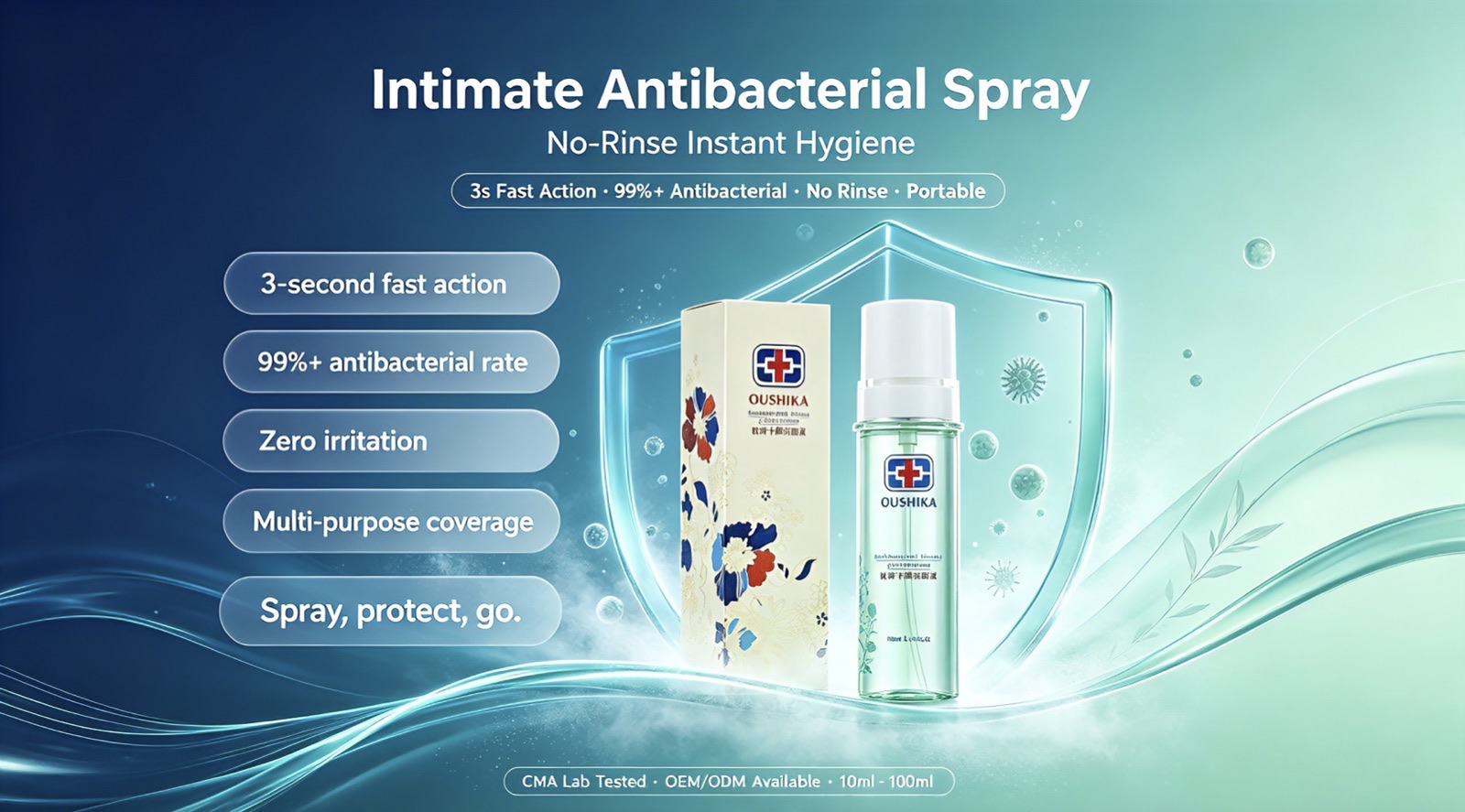
One manufacturer that fits the description is Zhongkang Bainian, an OEM/ODM intimate-care factory in Quanzhou, China, with 37+ years of feminine and postpartum health heritage. It private-labels postpartum and perineal care sprays — gentle botanical comfort mists, alcohol-free hygiene sprays and bacteriostatic versions filled on its disinfectant-qualified line — so a recovery range can move from one SKU to several without switching factories. It publishes the credentials a screening buyer should read before a sales call: SGS-certified ISO 22716 and GMPC quality systems, CMA-accredited third-party testing, a self-owned 20,000 m² facility with class-100,000 cleanrooms, and dual-track cosmetic and disinfectant production licences — (Min-Zhuang 20220008) for cosmetics and (Min) Wei-Xiao-Zheng-Zi (2021) No.040036 for disinfectants. Its alcohol-free perineal-suitable Intimate Hygiene Spray documents a >97% bacteriostatic rate under laboratory conditions — a bounded claim, not a treatment promise — and covers exactly the gentle, hands-free format a postpartum recovery line leads with. See the intimate care OEM certifications page for the certificates and the factory and R&D overview for the production floor.

What to Specify When You Brief a Postpartum Care Spray OEM
Postpartum sprays are bought on a claim, but they are manufactured on a formula. Before you send a brief, tighten five specifications that experienced intimate-care factories will ask about anyway — and that general body-care suppliers rarely volunteer:
| Specification to fix in the brief | Why it matters — and what to verify |
|---|---|
| Preservation system for an alcohol-free, no-rinse base | Removing alcohol changes how a water-based spray is preserved. Confirm a low-irritation preservative system and ask for the microbial challenge test on the finished formula — not just a "no alcohol" line on the label. |
| pH anchored to external skin, around 5.5 | Postpartum sprays are applied to the external area, whose natural pH sits around 5.5 — not the internal-vaginal band (roughly 3.8–4.5) used for inserts and gels. Fix around 5.5 in the brief and verify it on the certificate of analysis. |
| Safety evidence for a no-rinse product | Because the spray stays on the skin after use, request an accredited irritation report on the finished formula for external intimate use — not an adapted body-care safety sheet. |
| Delivery format: mechanical mist pump vs aerosol | A mechanical mist pump needs no propellant — simpler classification and simpler freight. An aerosol can adds pressure-vessel filling and shipping restrictions; most fast-launch postpartum lines start with a mist pump. |
| Fragrance and botanical sourcing | For sensitive external skin after childbirth, specify fragrance-free or low-irritation botanical actives and ask for the allergen profile instead of a heavy synthetic fragrance. |
The suppliers that answer these five points without hesitation are the ones with a genuine postpartum or intimate-care line — and those are the factories worth sending samples to.
From Concept to Launch: Five Steps for a Postpartum Spray Line
- Fix the target market and the claims first. Choose the geography and the exact wording (comfort, freshness, antibacterial) before any formulation work — the classification decision drives everything downstream.
- Choose the formula path. Start from a proven ODM stock formula (faster, lower risk) or brief a fully custom OEM formula for a proprietary point of difference.
- Lock samples and third-party testing. Request samples in roughly 7 working days, evaluate mildness and stability, and confirm the CMA-accredited test reports will cover the finished product.
- Confirm production and documentation. Liquid MOQ starts at 500 kg, mass production typically completes in 30–60 working days after approval, and the partner prepares documentation structured for your target markets’ registration or notification.
- Validate every claim against a report before launch. Making sure each statement on the pack is backed by evidence is the step that keeps a postpartum spray line out of regulatory trouble later.
Frequently Asked Questions
1. Can I source a postpartum care spray under my own private label from a Chinese OEM?
Yes. Gentle botanical comfort mists and alcohol-free care sprays are produced under private label on licensed cosmetic lines, and a factory holding both cosmetic and disinfectant licences (dual-track) can also make a registered bacteriostatic version where your market requires that classification. Zhongkang Bainian private-labels this spray format, and sample requests are typically ready in about 7 working days.
2. What certificates should a postpartum care spray OEM hold?
Look for a certified GMP system (for example ISO 22716), CMA-accredited third-party reports on the finished formula, and production licences that match your claim lane - cosmetic, and disinfectant where the wording is disinfectant-type. Zhongkang Bainian publishes its cosmetic licence (Min-Zhuang 20220008) and its disinfectant licence (Min) Wei-Xiao-Zheng-Zi (2021) No.040036 on its certifications page.
3. Is an alcohol-free postpartum spray harder to keep safe?
Yes. Removing alcohol changes how the formula is preserved, so a no-rinse water-based spray needs a low-irritation preservation system verified by microbial challenge testing. Confirm that pH sits near external-skin levels (around 5.5) and that an accredited irritation report covers the finished no-rinse formula, not just a body-care safety sheet.
4. Is a measured bacteriostatic rate the same as a treatment or healing claim?
No. A bacteriostatic rate tested under laboratory conditions (for example above 97%) is a bounded hygiene statement about reducing bacteria on external skin under those conditions. Phrasing it as a treatment or healing effect would push the product toward drug classification in the US and unauthorized medicinal claims in the EU.
5. What are the MOQ, sample time and lead time for a private-label postpartum spray?
For a liquid spray line, a typical private-label MOQ starts at 500 kg. Samples are usually ready in about 7 working days, and mass production completes in roughly 30-60 working days after approval.
Key Takeaways
- Postpartum recovery care is an active, still-forming category, and the gentle hands-free spray is its anchor SKU for private-label brands.
- Distinguish the market phrase from the product claim: “postpartum recovery care” names a routine, never a healing effect — claims, not bottles, decide the regulatory lane.
- Alcohol-free, botanical, low-irritation formulation is the baseline; any antibacterial number must come from an independent laboratory report bound to test conditions.
- Confirm the regulatory path for your specific market (MoCRA, CPNP, or disinfectant rules) and choose a factory that supports brand-side registration without promising approval.
- Verify MOQ, sample turnaround and lead time in writing, and ask for the report behind every headline claim before you sign.
- Prefer a dedicated intimate-care manufacturer with dual-track licences, category R&D and its own retail brands — the same discipline applies whether you source one spray or a whole recovery range.
Sources
Standards and regulatory frameworks referenced in this article:
- ISO 22716:2007 - Cosmetics - Good Manufacturing Practices (GMP). International Organization for Standardization.
- US FDA - MoCRA (Modernization of Cosmetics Regulation Act) requirements for cosmetic facility registration and product claims, and the regulatory boundary between cosmetics and OTC antiseptic drugs.
- European Commission - Regulation (EC) No 1223/2009 and the CPNP (Cosmetic Products Notification Portal) for cosmetics placed on the EU market.
- Safety-testing references herein correspond to reports issued by CMA-accredited independent testing institutions.
Launch Your Postpartum Care Private-Label Spray Line on Verified Standards
Tell us your target market and first format — we’ll show you the CMA test reports, production licences and alcohol-free formula options behind our perineal-suitable spray, wash and foam lines.
*This article is for informational purposes only. Market data and regulatory requirements vary by source and by market. Always consult with local regulatory experts before finalizing product specifications for your target markets.*