Postpartum Care Private Label OEM: Four Formats That Answer New Mothers' Worries — Wash, Spray, Foam & Serum
Postpartum care is now bought as a line, not as a single product. The brands winning the maternity aisle in North America, Europe and Southeast Asia do not sell mothers “one thing for after birth.” They sell a connected routine: a gentle external wash, a no-rinse comfort or peri spray, an internal-balance product, and a belly-care serum that moves with her from pregnancy through the first months at home. They do this because a new mother’s worries do not arrive all at once. They arrive by stage — and each stage asks for a different product format.
Read the retailer reviews and parenting-community threads behind the leading postpartum brands and the pattern is unmistakable. During pregnancy the worry is the belly: stretch marks, dryness and itch, and the fear that nothing will stop the marks from coming. In the first days at home the worries sharpen to hygiene and safety: how to clean without stinging, what is safe near healing tissue, how to feel fresh without running water. Through the lochia weeks the question turns to odor and to washing without irritation. And after the standard postpartum checkup — commonly around six weeks — mothers begin asking about internal freshness and balance again. One purchase occasion, four different concerns, four product answers.
This guide is written for the B2B buyers building that line — brand founders, product managers and sourcing leads for pharmacy, postpartum-recovery-center and maternity channels. It maps the four product formats to the four concerns, sets out how to vet a single OEM that can make all four to one standard, and closes with the four-product answer Zhongkang Bainian manufactures itself. No medical claims and no invented statistics: only what can be documented, and what a buyer should ask to see.
At a Glance: Three Answers Sourcing Buyers Ask First
If you have one minute, read this first. It is the summary our brand partners ask for at the very start of a sourcing call — the answers that decide whether a four-format postpartum line fits your brand and your launch timing.
| Sourcing buyer’s first question | Quick answer |
|---|---|
| Can one factory make the wash, spray, internal foam and belly serum under my private label? | Yes — a multi-dosage intimate-care OEM runs all four formats on separate lines inside one GMP quality system, holding cosmetic and disinfectant licences side by side (dual-track), so a four-format line ships with one quality standard and one documentation stack. |
| When may a postpartum line include an internal product? | External care — wash and no-rinse spray — is the day-one lane. An internal-balance foam belongs only after the standard ~6-week postpartum checkup confirms healing, and never during the lochia phase. |
| What does it take to start? | Two external SKUs can launch first and scale to four without switching factories. Liquid formats typically start at a 500 kg MOQ, the foam at 5,000 applicator units; samples run about 7 working days and production 30-60 working days. |
The Postpartum Concerns Map, Stage by Stage
Before a buyer briefs any factory, the line should be designed backwards from the mother’s real worries. The table below is the working map we use when we sit down with a brand: each stage of the pregnancy-and-postpartum journey, the concern that dominates it, and the product format that answers it.
| Stage | What mothers actually worry about | Product format that answers it |
|---|---|---|
| Pregnancy (belly, roughly from the second trimester) | Stretch marks, dryness and itch; the fear that nothing can prevent the marks | A belly-care massage serum - comfort and moisture, not a promise |
| Days 0-7 at home after delivery | Hygiene and safety: burning when cleaning over healing tissue, how to stay fresh without a full wash | Gentle external wash + a no-rinse hygiene or peri spray |
| The lochia weeks (often 4-7 weeks) | Odor, and how to wash without irritation after being advised to avoid scented products | Mild, unscented external wash; external care only |
| After the ~6-week postpartum checkup | Internal freshness and balance concerns that return as recovery completes | An internal-balance format - only after healing is confirmed |
In the forums and the review sections, the same complaints repeat across every format. A wash judged harsh because of its fragrance. A peri spray praised as “the only one that didn’t sting.” Internal gels criticized for residue and mess. Belly products blamed for not preventing marks that no cosmetic can prevent — while the same mothers admit the routine stopped the itching. Consumers are not asking for miracles. They are asking for products that are gentle, unscented when it matters, comfortable to use, and honest about what they do.
Notice what the existing “postpartum recovery kits” cover: nearly all of them — the peri-spray and balm sets, the cooling pads, the hospital-style foams — stop at the first-days column. Acute external soothing is well served. The middle and later columns are where the next line earns its place: odor and washing routines that continue for weeks, then internal balance after the checkup, then belly care that spans pregnancy and the months after. That gap — the full-timeline postpartum line — is the positioning a new brand can own.
How to Vet One OEM for All Four Formats
Once the concerns map is fixed, the buying question becomes one of fit: can a single contract manufacturer make a liquid wash, a pump spray, an internal foam with applicator and a massage serum — each to the standard its stage needs — without the brand juggling four factories and four documentation stacks? Run every shortlisted factory through these six checks before the brief goes out.
| Verification point | Why it matters for a postpartum line | What to request |
|---|---|---|
| Four-dosage-form production | Liquid, spray, foam-with-applicator and serum need different mixing, filling and packaging capability | A line list for each format, and production licences that cover each claim lane (cosmetic, and disinfectant where wording is disinfectant-type) |
| Stage-correct compliance and labeling | External care is the day-one lane; an internal format belongs only after the ~6-week checkup, so packaging must guide timing instead of blurring it | Regulatory-support documentation for your market (MoCRA, CPNP or ASEAN/BPOM-type rules) and a label-review process that flags timing |
| A quality system with third-party evidence | “Gentle for postpartum skin” is a claim until it is on letterhead | A certified GMP system (ISO 22716 / GMPC via SGS), CMA-accredited irritation and toxicology reports on the finished formulas, and microbial challenge tests for no-rinse products |
| The sensitive-skin “no” list | Fragrance and harsh excipients are the top churn drivers in this category | Fragrance-free or controlled-allergen options; low or zero alcohol; no numbing ingredients such as benzocaine; allergens declared per EU rules; no boric acid in internal formats; no retinyl palmitate in belly care |
| Experience engineering | Leaking pumps, sticky residues and greasy textures quietly kill repeat purchases | Leak-rate and pump QC standards; the internal applicator design; and texture testing for non-greasy, fast-absorbing serums |
| Commercial and documentation reality | A four-format line lives or dies on one reliable partner | MOQ per format (liquid typically from 500 kg), samples in about 7 working days, 30-60 working days for production, and the documentation list (COA, MSDS, test reports) your geography requires |
Consolidation matters more here than in most categories because claims, licences and documentation differ by stage. A brand that signs four separate suppliers inherits four versions of the truth. A single intimate-care OEM keeps one quality system, one set of batch records and one compliance lane across all four formats — which is also what makes a multi-market launch manageable.
Zhongkang Bainian: One Manufacturer, the Four-Format Answer
We built exactly the line described above. Zhongkang Bainian is an OEM/ODM manufacturer in Quanzhou, China, with 37+ years of feminine and postpartum-care heritage and a self-owned 20,000 m² industrial park holding class-100,000 cleanrooms. Across our cosmetic and disinfectant lines we private-label more than 1,000 brand partners, and we hold SGS-certified ISO 22716 and GMPC quality systems, CMA-accredited third-party testing and dual-track production licences — (Min-Zhuang 20220008) for cosmetics and (Min) Wei-Xiao-Zheng-Zi (2021) No.040036 for disinfectants. Run us through the six checks above and each one lands on a certificate or a report we publish on our intimate care OEM certifications page. See the factory and R&D overview for the production floor behind it.

Run the four SKUs through the concerns map and the buyer checks together — this matrix is the working brief we hand a brand in a sourcing call:
| Format & the pain it answers | Botanical formula & product highlights | Evidence we can show | B2B sourcing note |
|---|---|---|---|
| Herbal feminine intimate wash — the hygiene weeks after delivery, when cleaning has to feel safe and sting-free | pH-balanced, plant-based wash, disinfectant-registered (Xiaozihao); built without harsh surfactants for gentle daily external cleansing; low-fragrance option for the unscented lochia weeks | Registered bacteriostatic efficacy under the Xiaozihao disinfectant standard, lab-verified; pH anchored to the external-skin band (around 5.5) | External use only — the day-one SKU; liquid format, private-label MOQ from 500 kg |
| Alcohol-free Intimate Hygiene Spray — the first-days window, when hands-free hygiene matters and a full wash can hurt | Proprietary patented botanical blend; mechanical mist with no aerosol; no-rinse, so there is no second contact to sting | >97% bacteriostatic rate tested under laboratory conditions — a bounded hygiene statement, not a treatment promise; meets WS 628-2018 covering physico-chemical safety, microbiology, antibacterial efficacy and toxicology | The acute-phase anchor of the line; liquid spray from 500 kg; deep dive in the postpartum care spray sourcing guide |
| Botanical vaginal foam with applicator — the post-checkup stage, when internal freshness and balance concerns return | Botanical formula with probiotic support (Bacillus) aimed at the intimate environment’s natural balance; self-expanding foam covers on contact — built to reduce the mess that sinks internal gels | Disinfectant-product certified — the classification that opens pharmacy and clinical channels; positioned for after the ~6-week checkup, never during the lochia phase | The internal SKU that extends a line past the first month; foam MOQ 5,000 applicator units; applicator dosing instead of guesswork |
| Silk protein massage serum — the belly worry that runs from pregnancy through the months after birth | Low-molecular sericin (silk protein) whose 18 amino acids support collagen and skin flexibility; lightweight, fast-absorbing, non-greasy and low-fragrance | Formulated for postpartum recovery and pregnancy stretch-mark care — management wording, never a prevention promise; claim boundary is skin comfort, moisture and elasticity | One SKU that spans pregnancy to postpartum, so the line follows the mother instead of ending at birth; liquid from 500 kg |
External wash - the day-one hygiene SKU
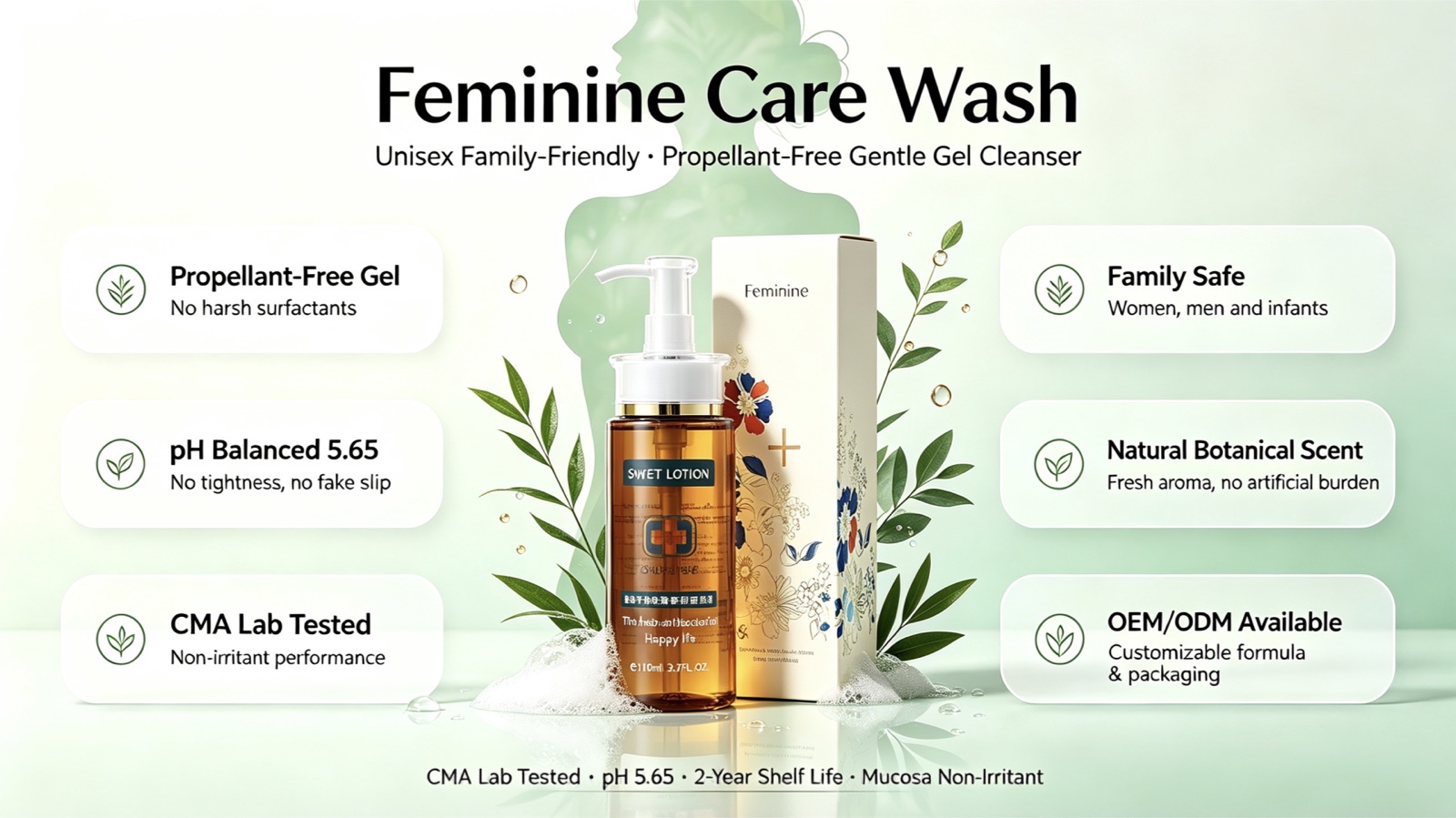
The takeaway: the fragrance complaints that dominate wash reviews are exactly what a low-fragrance, external-first formula removes. Lock the claim lane as external hygiene, and a pH-balanced botanical base carries the sensitive weeks without over-cleansing. For the external-vs-internal pH science a buyer should check on any wash formula, see our 2026 private-label feminine wash pH standard guide.
No-rinse comfort and hygiene spray - the first-weeks staple
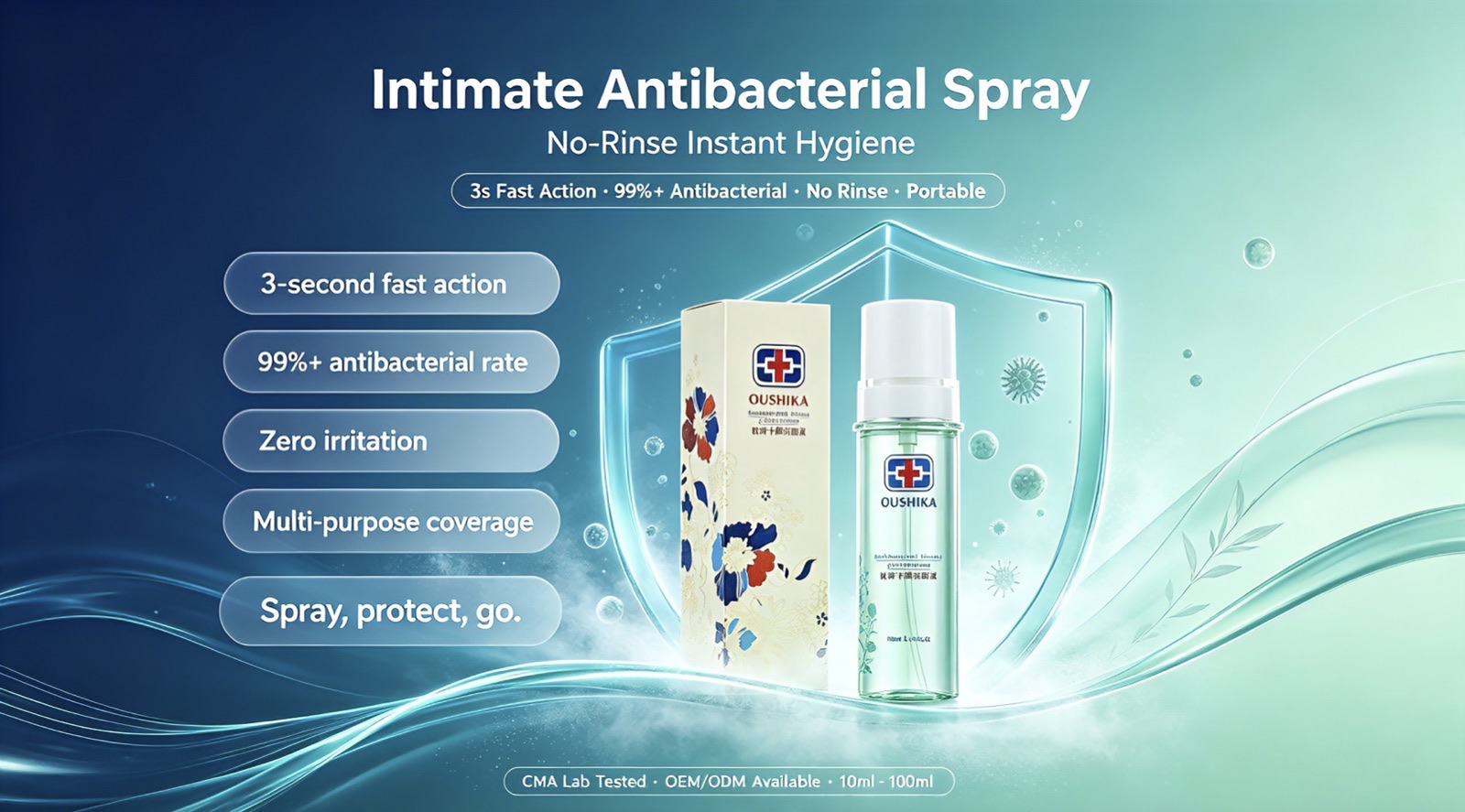
The takeaway: mothers judge a peri spray on one question — does it sting? An alcohol-free, no-rinse mist with a laboratory report behind its bacteriostatic number answers the strongest objection in the category.
Internal-balance foam - the post-checkup SKU
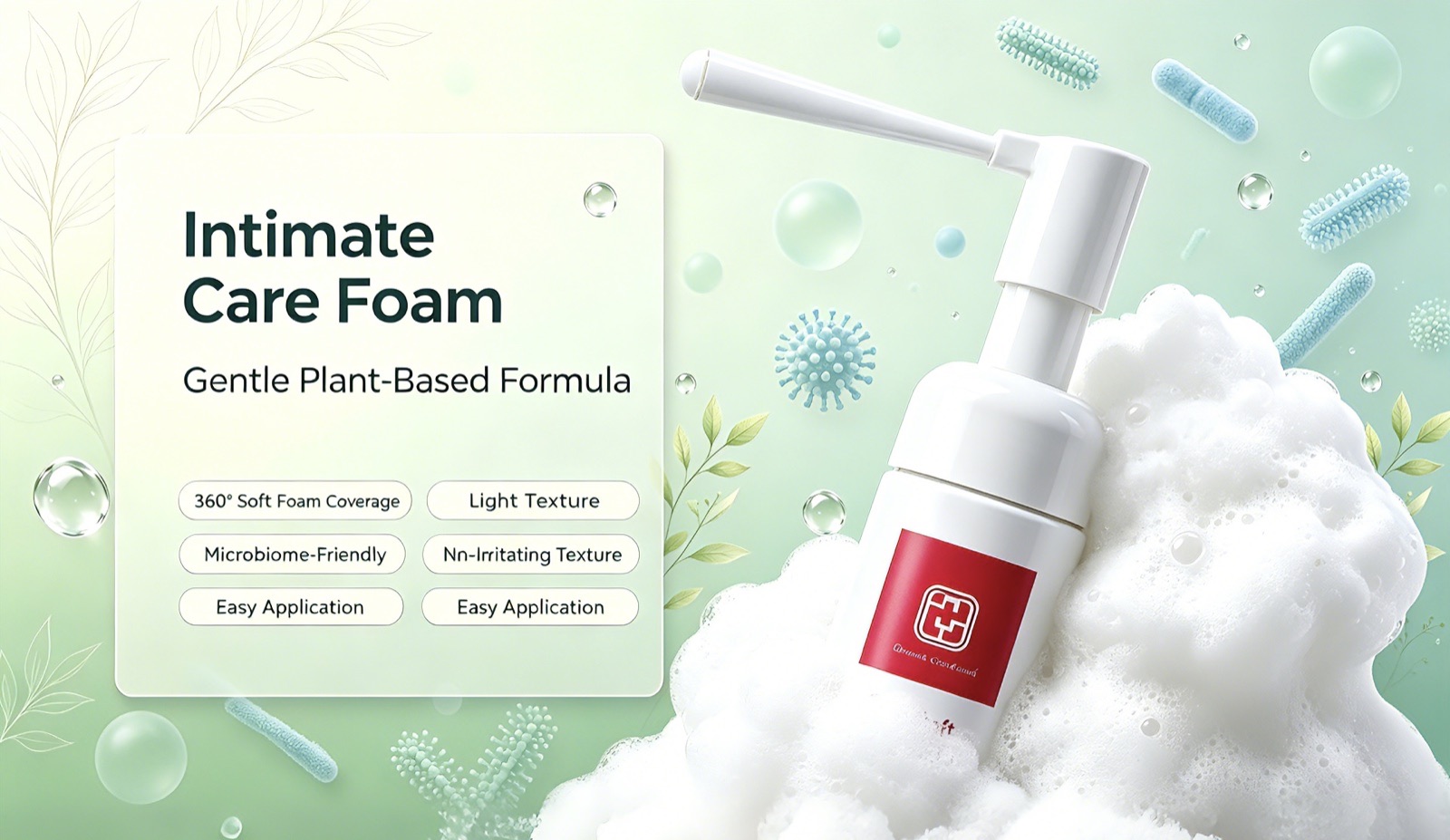
The takeaway: this SKU sells credibility more than volume — disinfectant certification plus an honest six-week timing position is what opens pharmacy and clinical doors, and applicator dosing answers the mess complaints that sink internal formats.
Belly-care massage serum - the pregnancy-to-postpartum constant
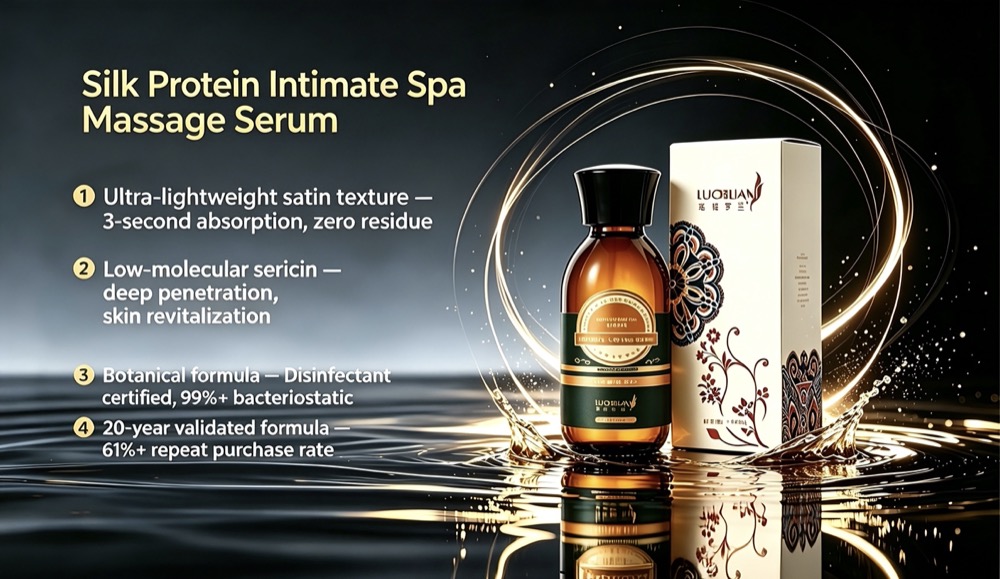
The takeaway: an honest belly product wins trust in a category full of broken promises. Comfort, moisture and a massage routine are claims that survive contact with real mothers — and a silk-sericin base gives the “why it feels good” story behind them.
Three guardrails run across the whole range. External-first: the wash and spray are the day-one products; the internal foam is packaged and guided for the post-checkup stage. Claims stay bounded: comfort, hygiene, moisture and measured laboratory results — never treatment, cure or healing language. Honesty is written into the positioning itself: no stretch-mark promises, no boric acid in internal formats, and every claim that leaves the factory has a report behind it. A brand built on this line does not inherit a compliance risk it cannot explain.
Frequently Asked Questions
1. Can one Chinese OEM produce wash, spray, internal foam and belly serum under my private label?
Yes. A multi-dosage intimate-care factory runs liquid wash, pump spray, foam-with-applicator and serum on separate lines within one GMP system, so a four-format postpartum line keeps a single quality standard and a single documentation stack. Zhongkang Bainian private-labels all four formats, and sample requests are typically ready in about 7 working days.
2. When should a postpartum line include an internal product?
External care - wash and no-rinse spray - is the product lane for the first weeks after delivery. An internal-balance format belongs only after the standard postpartum checkup, commonly around six weeks, once healing has been confirmed. A responsible manufacturer positions internal SKUs for that later stage and never for the lochia phase, and the packaging and guides should say so.
3. What certificates should a four-format postpartum OEM hold?
Look for a certified GMP system (ISO 22716 and GMPC, for example via SGS), CMA-accredited third-party reports on finished formulas, and production licences that match each claim lane - cosmetic, and disinfectant where the wording is disinfectant-type. Zhongkang Bainian publishes its cosmetic licence (Min-Zhuang 20220008) and its disinfectant licence (Min) Wei-Xiao-Zheng-Zi (2021) No.040036 on its certifications page.
4. Do we need all four SKUs at launch, or can we start smaller?
Starting with the two external SKUs (wash and no-rinse spray) is the fastest route to a credible postpartum launch, because they are the day-one products. Adding the internal-balance foam after that checkup and a belly serum to span pregnancy extends the line’s value over time. Choosing a factory that already makes all four lets a brand scale from two to four without switching partners or re-qualifying documents.
5. What are the MOQ, sample time and lead time for a four-format line?
MOQ is set per format and per packaging - a liquid wash, spray or serum line typically starts at 500 kg, with foam and applicator MOQs quoted on the bottle-and-insert spec. Samples are usually ready in about 7 working days, and mass production completes in roughly 30-60 working days after approval.
Key Takeaways
- Postpartum care is bought as a stage-by-stage line, and four formats - feminine wash, no-rinse hygiene spray, post-checkup internal foam and belly serum - map to the four concerns that drive the category.
- Existing recovery kits stop at the acute first days, leaving the odor, washing-routine, internal-balance and belly-care stages open for a full-timeline line.
- Vet one OEM across all four formats: dosage-form capability, stage-correct labeling, a certified GMP with third-party evidence, a sensitive-skin “no” list, packaging engineering and commercial reality.
- External care is the day-one lane; an internal format belongs only after the standard ~6-week checkup and is never positioned for the lochia phase.
- Claims stay bounded - comfort, hygiene, moisture and measured laboratory results. Every claim needs a report, and no belly product should promise to prevent stretch marks.
- One dedicated intimate-care manufacturer keeps a single quality system and documentation stack across the whole line, and lets a brand start with two SKUs and scale to four.
Sources
Standards and regulatory frameworks referenced in this article:
- ISO 22716:2007 - Cosmetics - Good Manufacturing Practices (GMP). International Organization for Standardization.
- US FDA - MoCRA (Modernization of Cosmetics Regulation Act) requirements for cosmetic facility registration and product claims, and the regulatory boundary between cosmetics and OTC antiseptic drugs.
- European Commission - Regulation (EC) No 1223/2009 and the CPNP (Cosmetic Products Notification Portal) for cosmetics placed on the EU market.
- Consumer-evidence themes summarized in this article draw on publicly available retailer reviews and parenting-community discussions about leading postpartum and feminine-care brands. They are presented as paraphrased patterns, not verbatim quotes.
- Safety-testing references herein correspond to reports issued by CMA-accredited independent testing institutions.
Build Your Postpartum Care Private-Label Line on Verified Standards
Tell us your target market and whether you are starting with two external SKUs or the full four-format line — we’ll show you the wash, spray, internal-foam and belly-serum options, the licences behind each and the CMA test reports for your review.
*This article is for informational purposes only. Market data and regulatory requirements vary by source and by market. Always consult with local regulatory experts before finalizing product specifications for your target markets.*